I was reading an article in
The Daily Egg and realized that all to often authors and publishers fall prey to the "summary of features" style when penning those brief descriptions that appear on Amazon, Barnes & Noble, and other bookselling sites.
Although they may well convey the type and scope of the book, they don't exactly tantalize the reader into wanting to find out more about what's inside the book.The same can be said of many author bio's.
So, before you send off that query, upload your catalog to the printer, or post that next book for sale, read the article, and then rewrite those book blurbs a bit . . .
5 Essential Qualities of Irresistible Product Descriptions
Product descriptions aren’t that hard: Just list a few features and move on, right?
Wrong.
Your product descriptions should position your product, target your
ideal customer, and set off a strong buy response. Features alone can’t
do that.
Just take a look at this high-end retailer’s description, and you’ll see what I mean.

Trusting customers to buy based on a brand name and photo alone is
like sending them on an ocean voyage in a rowboat. They might arrive
safely in port, but the odds are high that they’ll get lost along the
way.
People need help understanding what your product is and what it will
do for them. They need to know why your product is better than all the
alternatives.
And with so many brands
not investing the time to write useful
descriptions, you can easily stand out from the crowd. Just try one of
these five simple techniques to make your descriptions irresistible.
1) Spark imagination with vivid language: Teavana
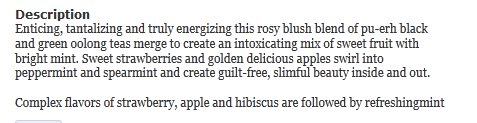
Tea, in and of itself, is nothing exciting. At least, not until
Teavana talks about it.
The key is to nix all neutral words that don’t inspire or persuade. Replace them with words that create mental images or an
emotional response.
Descriptions like
rosy blush blend,
enticing,
tantalizing and
intoxicating make this tea seem more than just another cup of caffeine. It’s an experience.
Then instead of listing ingredients, Teavana takes it to the next level by telling us how we’ll feel when we drink it.
Guilt-free, slimful beauty? Who doesn’t want that?
How you can do it
First, decide on the primary emotion you want people to feel when they think about your product.
Then look for words that elicit those feelings. If you need help, use a reverse dictionary like this one from
OneLook.
Now write a description that incorporates some of those words. Don’t
just talk about your product. Help people experience it by showing them
how their life will be changed by it.
2) Add spice with sensory details: Whole Foods Market

Specifics sell. And this description by
Whole Foods Market proves it.
The implicit suggestion is that this pizza will transport you to
Italy, where pizza isn’t a fast-food industry but a way of life.
Look at the details in the description. You may not immediately recognize
schiacciata style pizza,
but it enhances the trip-to-Italy metaphor. We’re even told the
specific village where the pizza is made, Friuli, and if you keep
reading, the meaning of
schiacciata.
These types of details are what keep people reading, while colorful, sensory details help them visualize your product.
In this case, you can almost see the pizza being made: the crackle of
the wood fire, the bright red cherry tomatoes, the smell of the rising
yeast and the crunch of a thin, crispy crust.
How you can do it
Don’t just list features and benefits. Make your description a sensory experience.
Find ways to engage as many senses as possible: sight, sound, touch,
smell, and taste. Weave in interesting facts about your product: where
or how it’s made, who uses it, and anything else that could pique
people’s interest.
3) Jazz it up with active verbs: White House Black Market
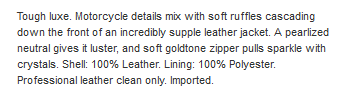
If you don’t have time to try any other tip, make time for this one.
The heart of any sentence — and the power — lies with verbs.
The temptation is to say, “This leather jacket is a surprising mix of
motorcycle details and soft ruffles.” But where is the action?
Instead,
White House Black Market uses strong verbs. Motorcycle details
mix with ruffles. And not just any ruffles, but
cascading ruffles. A pearlized neutral
gives it luster. And the zipper
pulls sparkle.
Don’t be afraid to surprise readers with an unusual noun-verb
combination. Who would have guessed that a pearlized neutral could give
luster? But here it does, and it sounds surprisingly attractive.
How you can do it
When writing your descriptions, try to avoid all passive verb
constructions. For instance, “A jacket was made,” is passive. “Designers
made this jacket,” is active.
Things don’t magically happen. Someone or something performs the
action. That’s active, and it’s a powerful way to energize your
descriptions.
When you’re done writing, read through your copy to find all weak or boring verbs. Replace them with vivid, colorful ones.
4) Connect the dots for readers: Wolferman’s

People don’t always make the connection between features and benefits.
If your product can change people’s lives, you need to tell them
clearly. Even if it’s as simple a benefit as having your English muffin
stand up to the toughest topping.
Just as
Wolferman’s explains why thick muffins are more satisfying, tell people how your product’s features will change their lives for the better.
How you can do it
When you list a feature, tie it to a benefit. When you list a benefit, explain the feature that creates that benefit.
It doesn’t matter which comes first. You simply need to create a
strong association between your product and your customer’s happiness.
5) Create an identity: Think Geek

People who identify with a certain group or class of people love products that help them express membership in that group.
It may be fan mentality, as when football fans wear the star
quarterback’s jersey. Or it could be a sense of exclusivity, as when
fraternity brothers wear a particular ring.
In this case,
Think Geek
knows that many professionals are really geeks in disguise. They craft a
description that helps these people maintain their gamer identity, even
while sporting a suit and tie.
This approach takes more space, but it can be very persuasive. Notice
the description starts with the problem, having to replace gamer
t-shirts with a pinstripe shirt. It then provides a solution, using a
gamer’s backpack instead of a briefcase.
This approach creates such a strong identity with the product that
details don’t matter to the buyer. It’s what the bag represents that’s
important, not what it does.
How you can do it
Don’t just describe your product, describe it in terms of your
customers. How will this product benefit them? Why should they choose it
over every other option?
Make them feel special. Like members of an elite group. Then focus on
the features that relate specifically to members of that group.
A little improvement can help a lot
So few brands see the value of writing strong product descriptions, it isn’t hard to make your descriptions stand out.
You only need to find the reasons people buy and the words to prove you get it, and you can easily beat the competition.
What about you? Do you have other tips for irresistible descriptions? Share them in the comments below.
About the Author: Kathryn Aragon is an award-winning copywriter, content marketer and editor of the
C4 Report. Connect with
Kathryn on Twitter.
To read the full article or subscribe to
The Daily Egg,
CLICK HERE